
July 30, 2026
The five functions of money
Money has five jobs. They don't change. The rails do.
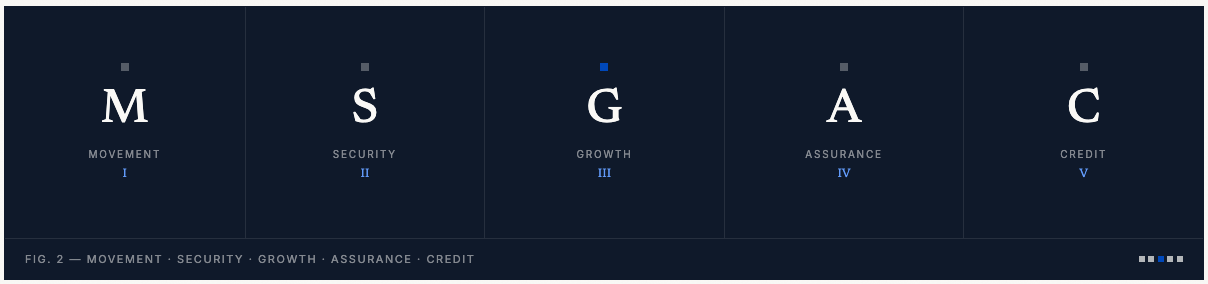
Movement. Security. Growth. Assurance. Credit. Five functions that defined the fiat world are migrating to programmable, always-on rails — and the disciplines that picked winners on the old rails will pick them on the new ones.
{{5-funcs-timeline}}

Why a framework
Most tokenization narratives decide nothing. This one is built to.
Most tokenization decks fail in one of two ways. They lapse into technology tourism — chains, wallets, oracles — which flatters the audience but decides nothing. Or they collapse into a market map of logos, which reads as coverage but confers no point of view.
The Five Functions framework reframes tokenization not as a novel asset class but as a set of upgrades to a very old operating system — the one fintech has been rebuilding, piece by piece, for two decades.
Its power comes from a single assertion: the functions money performs are constant, but the rails change with every technology cycle — cash to cards, cards to mobile, mobile to PIX and UPI.
Tokenization is simply the next rail — the most consequential in a generation, because for the first time all five functions can be reconstituted on a single programmable, globally accessible, 24/7 settlement layer.
{{5-funcs-timeline-today}}

The five functions
Operator language, not economist language.
Every fintech balance sheet in the world resolves to some combination of five verbs. A neobank does Security and Movement. A wealth platform does Growth. An insurtech does Assurance. A card issuer does Credit and Movement. The jobs do not change — the cost, reach, speed and composability of doing them changes profoundly.
{{5-functions-of-money}}
What tokenization changes
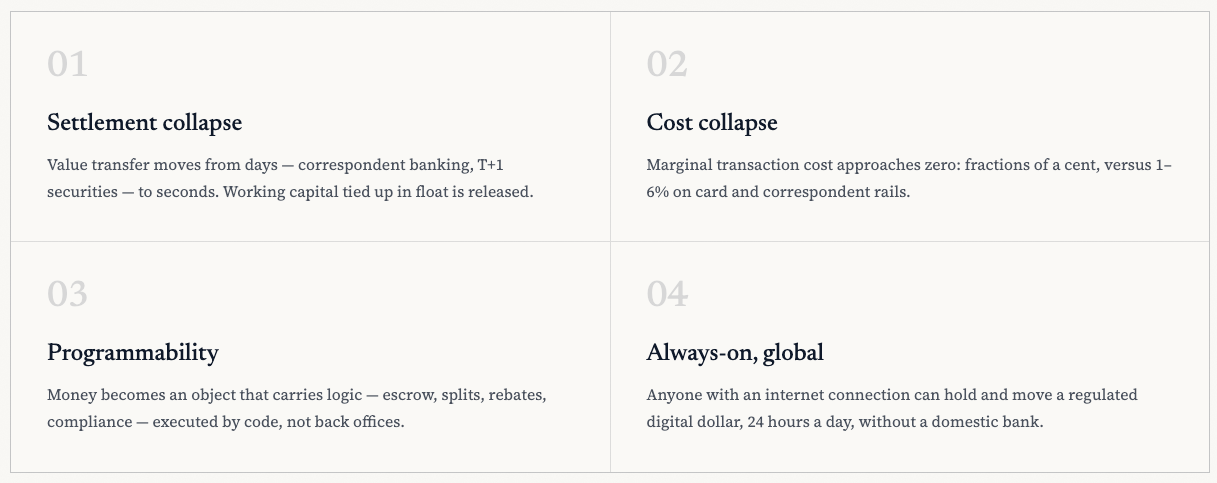
Not one change — four physical properties, resetting every unit economic
{{5-funcs-insight}}
Function by function
Five jobs, one discipline: underwrite where the value actually accrues
Movement
I · Payments · Pay · Send · Collect
The job: Get value from one party to another, ideally instantly and at zero cost.
The fiat-world state
A fragmented stack of card networks, ACH, SWIFT and country-specific real-time schemes. Domestic payments have improved dramatically; cross-border has barely moved — remittance corridors still average 6% cost and multi-day settlement. A $200T+ annual flow with structurally poor unit economics for the customer.
What tokenization does
Stablecoin settlement compresses cost to under 1% and time to seconds. 2025 volume of roughly $33 trillion (+72% YoY) already rivals the card networks — yet only ~1% of it is true end-user payments. That is not the ceiling; it is the floor. Consensus (including QED × McKinsey) points to $2–4T of stablecoin payment volume by 2030.
Where durable value accrues
Corridor specialists: Last-mile fiat on/off-ramps in specific geographies. Félix Pago moves US→LatAm remittances over WhatsApp on USDC settlement the sender never sees.
B2B orchestrators: Enterprise-grade compliance, treasury and accounting wrapped around stablecoin rails — Cedar Money and Cobre are QED bets here.
Agentic commerce: When AI agents transact autonomously, they settle in programmable dollars by default. The merchant relationship for agent-driven payments is the next Stripe.
Why QED is advantaged
Payments has been QED's densest investment area for two decades. Picking corridor winners, understanding interchange economics and evaluating fraud at real payment volumes is a QED specialty.
Security
II · Savings & Custody · Save · Hold · Safeguard
The job: Store value where it will not be lost to theft, fraud, inflation or institutional failure.
The fiat-world state
The neobank era — Nubank, Chime, Revolut — was a Security business: trust built through licensing, deposit insurance and superior digital experience. In emerging markets, roughly two billion adults lack easy access to a stable-currency account; local currency exposure is itself a Security risk.
What tokenization does
A regulated digital dollar account — globally portable, always on, holdable by anyone with a smartphone — is a genuinely new financial primitive. The $310B of stablecoin float outstanding, 99% dollar-denominated, is best read as a global demand curve for digital dollar savings.
Where durable value accrues
Stablecoin-native neobanks: KAST is QED's lead bet: a licensed spend-and-save experience denominated in stablecoins. Raenest does the analogous work for African dollar accounts.
Wallet & custody infrastructure: The picks-and-shovels layer — key management outsourced by enterprises and applications (Privy, Fireblocks, Utila, Dfns).
Identity, KYC & fraud: These functions don't disappear on-chain; they get rebuilt. Footprint (QED portfolio) sits exactly on this seam.
Why QED is advantaged
Every neobank thesis QED has ever underwritten — Nubank included — was a Security business in disguise. Deposit behavior, CAC/LTV, fraud losses and the licensing playbook are home turf.
Growth
III · Investing & Yield · Invest · Yield
The job: Compound value over time through productive assets and yield-bearing instruments.
The fiat-world state
Retail investing is a mature, distribution-dominated business. Whoever owns the customer relationship — Schwab, Robinhood, Nubank Invest, XP, Zerodha — captures most of the economics; asset issuers are largely commoditized.
What tokenization does
Tokenized real-world assets are moving on-chain at industrial scale: tokenized US Treasuries went from under $1B in early 2024 to ~$13B by mid-2026 — a 15x move in two years, anchored by BlackRock's BUIDL, Franklin Templeton and Circle's USYC. Stablecoin balances become natively yield-bearing, and collateral becomes a 24/7 mobile property.
Where durable value accrues
EM retail investment platforms: Midas — QED's Turkey/MENA bet at a ~$1B valuation — owns the retail investment pipe in a dollar-hungry emerging market: the distribution channel for tokenized US assets.
Institutional access layers: Ondo, Securitize and peers converting traditional issuances into on-chain form.
Yield-bearing dollar products: Treasury yield passed natively into spending accounts — the reason KAST matters beyond Security.
Why QED is advantaged
QED has underwritten investment distribution repeatedly across LatAm and beyond. We know the difference between a distribution moat and a product feature.
Assurance
IV · Insurance · Insure · Hedge
The job: Transfer the risk of a loss event to a counterparty willing to bear it.
The fiat-world state
Insurance is where financial services is most broken and most protected by incumbency at once. Underwriting has always been a data business dressed up as an actuarial one; the insurtech generation proved data and distribution can rewire it.
What tokenization does
Tokenization creates new categories of risk — custody failure, smart-contract exploits, oracle failure, depeg risk, issuer failure — and programmable claims execution: policies that pay out automatically on a defined, oracle-verified trigger, collapsing days of claims administration into seconds.
Where durable value accrues
Deliberate white space: The category has not been won — Nexus Mutual and a handful of cover protocols exist; enterprise-grade offerings are in pilot. Proof-of-reserves attestation and custody insurance carry the earliest real premium flow.
A live area within 12–18 months: QED would rather be honest about white space now than backfill portfolio into a hastily chosen category.
Why QED is advantaged
Underwriting risk on data is the specific muscle QED's insurtech portfolio has built for years. When on-chain Assurance matures, operators who price risk on data — not ideology — win. That is a fight QED is built for.
Credit
V · Lending · Borrow · Lend
The job: Bring future purchasing power into the present against expected repayment.
The fiat-world state
Credit is QED's founding DNA — leadership forged at Capital One, arguably the most important credit underwriting institution of the past 30 years. The modern portfolio spans consumer, SMB, cards, BNPL, trade finance and specialty credit.
What tokenization does
Digital-asset-backed lending collapses the operational cost of secured credit (Figure has pushed HELOCs on-chain at material volume). Stablecoin-settled trade finance eliminates settlement drag from cross-border SMB credit. On-chain private credit replaces quarterly LP letters with real-time loan-performance transparency.
Where durable value accrues
Trade & working-capital finance: Finkargo (LatAm import finance) and OatFi (B2B working-capital infrastructure) sit directly on flows whose logical settlement layer is stablecoin.
Collateralized digital-asset lending: Tokenized Treasuries, equities and stablecoin holdings as instant, programmable collateral.
On-chain private credit: Maple, Centrifuge and emerging institutional protocols — credit funds migrating to programmable rails.
Why QED is advantaged
Credit is QED's craft: distinguishing lending businesses from fintechs pretending to be one, charge-offs earned from charge-offs deferred. On-chain credit is a straight-line extension, not a stretch.
Cross-cutting implications
Three structural truths cut across all five functions
- Regulated-first wins
The 2020/21 cycle proved permissionless purity does not survive contact with real financial regulation. GENIUS, MiCA, CLARITY and the UK/Singapore regimes are producing founders who start from “how do we get licensed” and build backwards — precisely the founder profile QED has always preferred.
- Incumbents upgraded, not disintermediated
JPMorgan, Citi, Bank of America and Wells Fargo are jointly building a tokenized-deposit network; Visa launched a stablecoin platform in July 2026; 140+ businesses signed an open stablecoin standard. Banks migrate — and new-generation infrastructure companies own the picks and shovels of that migration.
- Emerging markets feel it first
Every function improves most where the fiat experience is worst: cross-border payments, dollar access, investment product availability, working-capital finance. Those are exactly the geographies where QED has fintech venture's deepest footprint. Our geographic distribution is not incidental to the tokenization thesis — it is the thesis.
What we rule out
A discipline is only as strong as what it disqualifies
- Pure infrastructure with no revenue accrual
Layer-1 chains and general-purpose middleware — outside our circle of competence and typically outside our stage.
- Speculative asset creation
NFT platforms, memecoins, prediction markets styled as products — mapping to none of the five functions; structurally uninvestable for us.
- Regulatory-arbitrage plays
Companies whose primary edge is operating where they have not yet been regulated carry compliance risk we are not compensated for.
If a company is not doing movement, security, growth, assurance or credit in a way that gets better on tokenized rails, we default to a pass.
The takeaway
{{5-functions-of-money-takeaway}}
The rails change. The trust and underwriting compound. That is QED's edge, carried into the tokenized era.
The rest is portfolio proof.
Money has five jobs. They don't change. The rails do.
Movement. Security. Growth. Assurance. Credit. Five functions that defined the fiat world are migrating to programmable, always-on rails — and the disciplines that picked winners on the old rails will pick them on the new ones.
{{5-funcs-timeline}}
Why a framework
Most tokenization narratives decide nothing. This one is built to.
Most tokenization decks fail in one of two ways. They lapse into technology tourism — chains, wallets, oracles — which flatters the audience but decides nothing. Or they collapse into a market map of logos, which reads as coverage but confers no point of view.
The Five Functions framework reframes tokenization not as a novel asset class but as a set of upgrades to a very old operating system — the one fintech has been rebuilding, piece by piece, for two decades.
Its power comes from a single assertion: the functions money performs are constant, but the rails change with every technology cycle — cash to cards, cards to mobile, mobile to PIX and UPI.
Tokenization is simply the next rail — the most consequential in a generation, because for the first time all five functions can be reconstituted on a single programmable, globally accessible, 24/7 settlement layer.
{{5-funcs-timeline-today}}
The five functions
Operator language, not economist language.
Every fintech balance sheet in the world resolves to some combination of five verbs. A neobank does Security and Movement. A wealth platform does Growth. An insurtech does Assurance. A card issuer does Credit and Movement. The jobs do not change — the cost, reach, speed and composability of doing them changes profoundly.
{{5-functions-of-money}}
What tokenization changes
Not one change — four physical properties, resetting every unit economic
{{5-funcs-insight}}
Function by function
Five jobs, one discipline: underwrite where the value actually accrues
Movement
I · Payments · Pay · Send · Collect
The job: Get value from one party to another, ideally instantly and at zero cost.
The fiat-world state
A fragmented stack of card networks, ACH, SWIFT and country-specific real-time schemes. Domestic payments have improved dramatically; cross-border has barely moved — remittance corridors still average 6% cost and multi-day settlement. A $200T+ annual flow with structurally poor unit economics for the customer.
What tokenization does
Stablecoin settlement compresses cost to under 1% and time to seconds. 2025 volume of roughly $33 trillion (+72% YoY) already rivals the card networks — yet only ~1% of it is true end-user payments. That is not the ceiling; it is the floor. Consensus (including QED × McKinsey) points to $2–4T of stablecoin payment volume by 2030.
Where durable value accrues
Corridor specialists: Last-mile fiat on/off-ramps in specific geographies. Félix Pago moves US→LatAm remittances over WhatsApp on USDC settlement the sender never sees.
B2B orchestrators: Enterprise-grade compliance, treasury and accounting wrapped around stablecoin rails — Cedar Money and Cobre are QED bets here.
Agentic commerce: When AI agents transact autonomously, they settle in programmable dollars by default. The merchant relationship for agent-driven payments is the next Stripe.
Why QED is advantaged
Payments has been QED's densest investment area for two decades. Picking corridor winners, understanding interchange economics and evaluating fraud at real payment volumes is a QED specialty.
Security
II · Savings & Custody · Save · Hold · Safeguard
The job: Store value where it will not be lost to theft, fraud, inflation or institutional failure.
The fiat-world state
The neobank era — Nubank, Chime, Revolut — was a Security business: trust built through licensing, deposit insurance and superior digital experience. In emerging markets, roughly two billion adults lack easy access to a stable-currency account; local currency exposure is itself a Security risk.
What tokenization does
A regulated digital dollar account — globally portable, always on, holdable by anyone with a smartphone — is a genuinely new financial primitive. The $310B of stablecoin float outstanding, 99% dollar-denominated, is best read as a global demand curve for digital dollar savings.
Where durable value accrues
Stablecoin-native neobanks: KAST is QED's lead bet: a licensed spend-and-save experience denominated in stablecoins. Raenest does the analogous work for African dollar accounts.
Wallet & custody infrastructure: The picks-and-shovels layer — key management outsourced by enterprises and applications (Privy, Fireblocks, Utila, Dfns).
Identity, KYC & fraud: These functions don't disappear on-chain; they get rebuilt. Footprint (QED portfolio) sits exactly on this seam.
Why QED is advantaged
Every neobank thesis QED has ever underwritten — Nubank included — was a Security business in disguise. Deposit behavior, CAC/LTV, fraud losses and the licensing playbook are home turf.
Growth
III · Investing & Yield · Invest · Yield
The job: Compound value over time through productive assets and yield-bearing instruments.
The fiat-world state
Retail investing is a mature, distribution-dominated business. Whoever owns the customer relationship — Schwab, Robinhood, Nubank Invest, XP, Zerodha — captures most of the economics; asset issuers are largely commoditized.
What tokenization does
Tokenized real-world assets are moving on-chain at industrial scale: tokenized US Treasuries went from under $1B in early 2024 to ~$13B by mid-2026 — a 15x move in two years, anchored by BlackRock's BUIDL, Franklin Templeton and Circle's USYC. Stablecoin balances become natively yield-bearing, and collateral becomes a 24/7 mobile property.
Where durable value accrues
EM retail investment platforms: Midas — QED's Turkey/MENA bet at a ~$1B valuation — owns the retail investment pipe in a dollar-hungry emerging market: the distribution channel for tokenized US assets.
Institutional access layers: Ondo, Securitize and peers converting traditional issuances into on-chain form.
Yield-bearing dollar products: Treasury yield passed natively into spending accounts — the reason KAST matters beyond Security.
Why QED is advantaged
QED has underwritten investment distribution repeatedly across LatAm and beyond. We know the difference between a distribution moat and a product feature.
Assurance
IV · Insurance · Insure · Hedge
The job: Transfer the risk of a loss event to a counterparty willing to bear it.
The fiat-world state
Insurance is where financial services is most broken and most protected by incumbency at once. Underwriting has always been a data business dressed up as an actuarial one; the insurtech generation proved data and distribution can rewire it.
What tokenization does
Tokenization creates new categories of risk — custody failure, smart-contract exploits, oracle failure, depeg risk, issuer failure — and programmable claims execution: policies that pay out automatically on a defined, oracle-verified trigger, collapsing days of claims administration into seconds.
Where durable value accrues
Deliberate white space: The category has not been won — Nexus Mutual and a handful of cover protocols exist; enterprise-grade offerings are in pilot. Proof-of-reserves attestation and custody insurance carry the earliest real premium flow.
A live area within 12–18 months: QED would rather be honest about white space now than backfill portfolio into a hastily chosen category.
Why QED is advantaged
Underwriting risk on data is the specific muscle QED's insurtech portfolio has built for years. When on-chain Assurance matures, operators who price risk on data — not ideology — win. That is a fight QED is built for.
Credit
V · Lending · Borrow · Lend
The job: Bring future purchasing power into the present against expected repayment.
The fiat-world state
Credit is QED's founding DNA — leadership forged at Capital One, arguably the most important credit underwriting institution of the past 30 years. The modern portfolio spans consumer, SMB, cards, BNPL, trade finance and specialty credit.
What tokenization does
Digital-asset-backed lending collapses the operational cost of secured credit (Figure has pushed HELOCs on-chain at material volume). Stablecoin-settled trade finance eliminates settlement drag from cross-border SMB credit. On-chain private credit replaces quarterly LP letters with real-time loan-performance transparency.
Where durable value accrues
Trade & working-capital finance: Finkargo (LatAm import finance) and OatFi (B2B working-capital infrastructure) sit directly on flows whose logical settlement layer is stablecoin.
Collateralized digital-asset lending: Tokenized Treasuries, equities and stablecoin holdings as instant, programmable collateral.
On-chain private credit: Maple, Centrifuge and emerging institutional protocols — credit funds migrating to programmable rails.
Why QED is advantaged
Credit is QED's craft: distinguishing lending businesses from fintechs pretending to be one, charge-offs earned from charge-offs deferred. On-chain credit is a straight-line extension, not a stretch.
Cross-cutting implications
Three structural truths cut across all five functions
- Regulated-first wins
The 2020/21 cycle proved permissionless purity does not survive contact with real financial regulation. GENIUS, MiCA, CLARITY and the UK/Singapore regimes are producing founders who start from “how do we get licensed” and build backwards — precisely the founder profile QED has always preferred.
- Incumbents upgraded, not disintermediated
JPMorgan, Citi, Bank of America and Wells Fargo are jointly building a tokenized-deposit network; Visa launched a stablecoin platform in July 2026; 140+ businesses signed an open stablecoin standard. Banks migrate — and new-generation infrastructure companies own the picks and shovels of that migration.
- Emerging markets feel it first
Every function improves most where the fiat experience is worst: cross-border payments, dollar access, investment product availability, working-capital finance. Those are exactly the geographies where QED has fintech venture's deepest footprint. Our geographic distribution is not incidental to the tokenization thesis — it is the thesis.
What we rule out
A discipline is only as strong as what it disqualifies
- Pure infrastructure with no revenue accrual
Layer-1 chains and general-purpose middleware — outside our circle of competence and typically outside our stage.
- Speculative asset creation
NFT platforms, memecoins, prediction markets styled as products — mapping to none of the five functions; structurally uninvestable for us.
- Regulatory-arbitrage plays
Companies whose primary edge is operating where they have not yet been regulated carry compliance risk we are not compensated for.
If a company is not doing movement, security, growth, assurance or credit in a way that gets better on tokenized rails, we default to a pass.
The takeaway
{{5-functions-of-money-takeaway}}
The rails change. The trust and underwriting compound. That is QED's edge, carried into the tokenized era.
The rest is portfolio proof.